Independent. Useful. Unapologetically Human. Subscribe Free

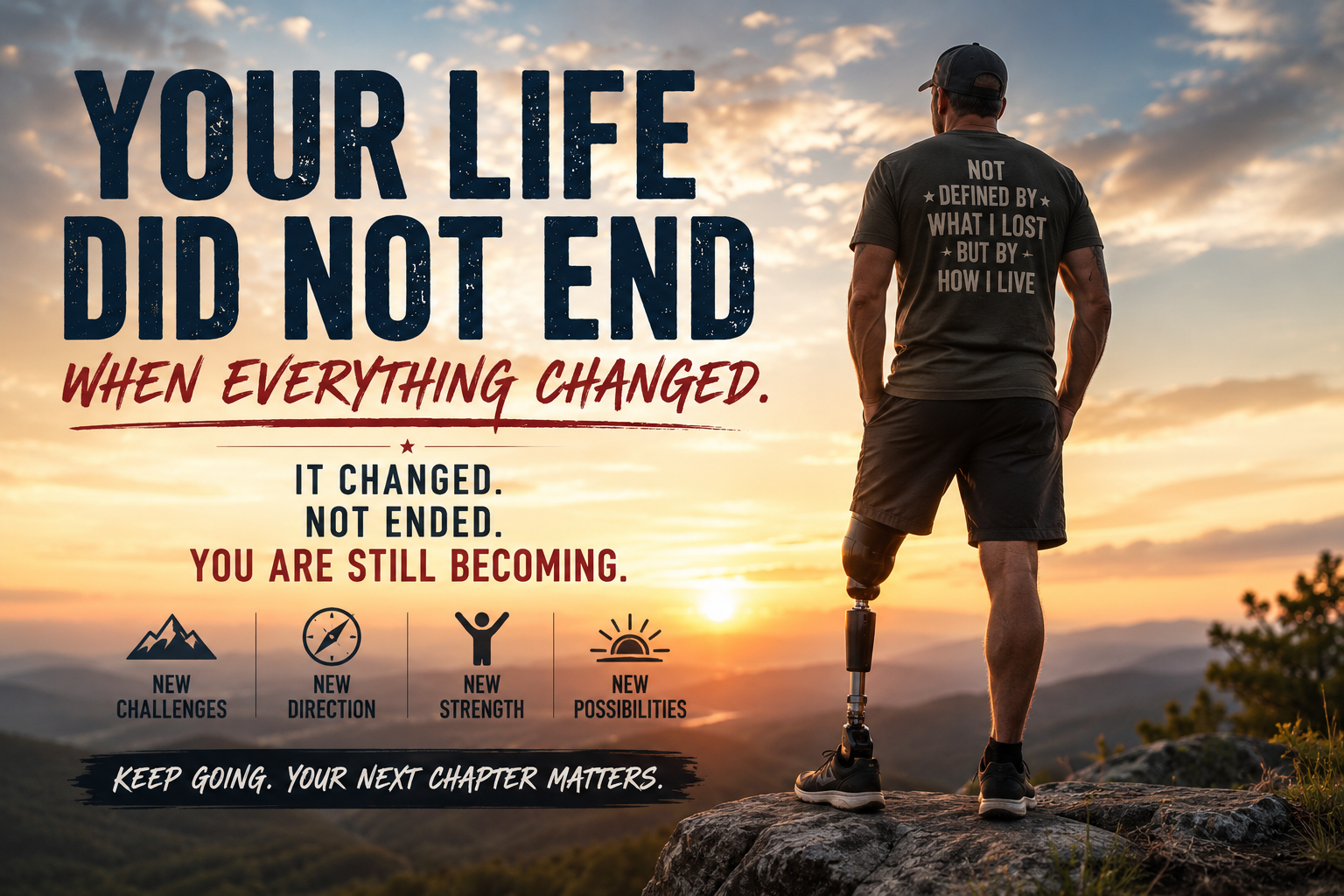
Your life did not end when everything changed.

There is a moment after limb loss when the world can feel divided into two parts: the life you had before, and whatever comes next. Before, you may have moved without thinking about it. You got out of bed, walked across a room, climbed into a truck, went to work, took a shower, carried groceries, played with your kids, or stood in line at the store without giving any of it much thought. Then something happened. An accident. An illness. An infection. A circulation problem. Cancer. A military injury. A surgery that could not be avoided.

And suddenly, ordinary things were no longer ordinary.

The world did not stop. Bills still arrived. People still expected answers. The dog still needed to go outside. Somebody still needed dinner. Your friends kept talking about their problems. Traffic still backed up at five o'clock. Life continued moving even while yours seemed to have slammed into a wall. That can be one of the hardest parts of becoming an amputee.

Everything changes, but...
Read the lead story →

Life On Our Terms

Living · Working · Adapting · Creating · Rebuilding

Work & Independence

Back on the job without pretending it was easy.

A returning worker talks about confidence, accommodations, fatigue, and the small adjustments that mattered most.

Continue reading →
Adaptive Life

The first solo trip after amputation.

What helped, what went wrong, and what this traveler would do differently next time.

Continue reading →
Family & Identity

Learning when to accept help — and when to say no.

Independence after limb loss is rarely a straight line. Neither is figuring out how much help is actually helpful.

Continue reading →

You Can't Make This Up

Verified absurdity from real life

Airport Edition

When the security checkpoint becomes a public anatomy lesson.

Screening procedures are one thing. Announcing private medical details to everyone within twenty feet is another.

The Ledger says: Respect is still free. Somebody should put that in the training manual.

Insurance Logic

The device is medically necessary. The part that makes it usable? Apparently optional.

Another reminder that coverage decisions and real life do not always occupy the same universe.

The Ledger says: A prosthesis that cannot do the job is not a bargain. It is a denial with extra paperwork.

Public Questions

Yes, strangers really do ask that.

Readers share the questions that made them stare silently for three full seconds before deciding whether to laugh.

The Ledger says: Curiosity is human. So is learning when not to ask.

Accessibility Failure

The accessible entrance that requires its own expedition.

When compliance exists on paper but the actual route sends people around the back, through a loading area, and past three locked doors.

The Ledger says: If the accessible route needs a treasure map, start over.

Beyond the Prosthesis

Reporting, context, consequences, next steps

Why is prosthetic access still so uneven?

What the headline says: New technology is making prosthetics more capable than ever.

What actually matters: A breakthrough is not much of a breakthrough if the person who needs it cannot get it, cannot afford it, or cannot get an insurer to cover it.

This department examines prosthetic access and affordability, insurance, rehabilitation, phantom limb pain, residual-limb care, mental health, employment, accessibility, transportation, relationships, aging, research, technology, and public policy.

The goal is not to tell readers what to think. It is to separate verified facts from assumptions, include lived experience, show the practical consequences, and explain what readers can do next.

Read the full report →

The Practical Ledger

Something useful every week

Flying with a prosthetic leg

A practical starting point for planning a smoother airport day.

This week's problemTravel-day screening, comfort, and backup supplies.
What may helpExtra time, a small repair kit, backup liners or socks, and a clear plan for screening.
CostVaries by supplies and equipment.
Who it may suitTravelers using a prosthesis who want fewer surprises at the airport.
LimitationsPolicies and personal medical needs vary. Verify current procedures before travel.
Open the full guide →

Questions worth asking before you buy

Before recommending a product, device, service, or adaptation, The Ledger asks what readers need to know.

Does it solve a real problem?Marketing claims are not enough.
What does it cost?Include realistic pricing when available.
Who is it for?Different bodies and amputation levels have different needs.
What are the drawbacks?Limitations belong in the review.
Material relationship?Affiliate links, free products, and sponsorships are disclosed.
Browse practical resources →

The Weekly Ledger

A fast-moving scorecard of the week

Amputee Achievement

A meaningful accomplishment from within the limb-loss community.

Voice of Reason

Practical, informed leadership without the usual noise.

Access Win

A place, policy, or organization that made something genuinely more accessible.

Access Failure

A preventable barrier that should have been fixed before anyone encountered it.

Worth Watching

Research, technology, or policy that may matter to readers.

Madness Meter

7.4 / 10

Civilization remains operational, but we're keeping an eye on it.

Signs of Sanity

Somebody got something right

An employer made the accommodation before being forced to.

Jason DiSanto and GE Power & Water.

DiSanto, an electrical engineer, became paralyzed from the neck down after a 2009 diving accident. When he was ready to return to work, GE did not wait for a complaint, lawsuit, EEOC action, or demand from an attorney. The company modified his workstation, provided voice-recognition software and a head-controlled mouse, allowed flexible hours, and permitted his personal aide to accompany him at work. He returned to his engineering job about a year after the injury. (Shepherd News)

The important distinction is that the accommodation worked and stayed in place. DiSanto continued working as an engineer, providing technical expertise to customers. Shepherd Center independently documented his return-to-work experience, while GE's own reporting corroborates the specific equipment and workplace modifications. (Shepherd News)

"An employer made the accommodation before being forced to." And GE didn't need to decide whether DiSanto could perform his job exactly as he had before his injury. They figured out what needed to change so he could still do the work.

Primary independent story:

Corroborating GE account:

The Unfinished Life

The emotional and human side of limb loss

Grief without surrender.

Identity, body image, confidence, dating, marriage, work, anger, embarrassment, independence, aging, family, and purpose belong here. The tone is honest rather than motivational by obligation.

Read the essay →

Stop calling basic accessibility a special favor.

One narrow frustration. One clear argument. One reasonable change. The target is a broken system, bad decision, misleading claim, or needless barrier — never the vulnerable person stuck dealing with it.

Read the rant →

Reader Dispatches & Community Board

The Ledger is better when readers are part of it

Reader Dispatch

"The advice that helped me most came from somebody who had already lived through the problem I was facing."

Respectful Disagreement

Readers are invited to disagree, correct, clarify, advise, and challenge The Ledger. Good arguments make the publication better.

Get The Ledger every Friday.

A story that makes you feel seen. Information you can use. A reason to laugh at the absurdity. And a reminder that limb loss did not end your life or your story.